Government and health organizations are changing for autism
On Sept. 22, the White House held a press conference to “confront the crisis of autism,” as said by president Donald Trump.
An FDA Notice to Physicians regarding the effects of acetaminophen on pregnant women would be issued the same day. The FDA stated that there is no established causal relationship between acetaminophen use during pregnancy and autism, but there are studies that have shown an association between the two. An association means that the two variables interact in some way but unlike a causal relationship, one variable does not cause the other.
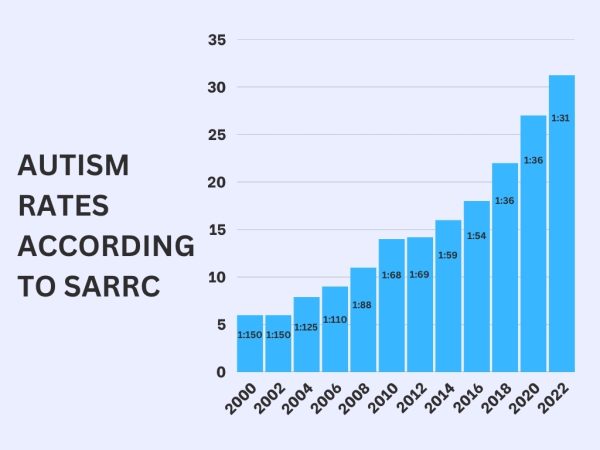
“The meteoric rise in autism is among the most alarming public health developments in history. It’s never been anything like this…Since 2000, autism rates have surged by much more than 400%,” said Trump.
Autism, also known as autism spectrum disorder or ASD, is a neurological disorder that can affect behaviors including but not limited to social interaction, sensory processing and motor skills. It is influenced by genetics and the environment. One significant contribution to this increase according to Southwest Autism Research and Resource Center is the broadening of the diagnostic criteria in 2013 from the fifth edition of the “Diagnostic and Statistical Manual of Mental Disorders,” or the DSM-5. Before, autism, asperger’s disorder and pervasive developmental disorder were separate diagnoses but were then combined into one diagnosis, ASD. Also said by SARRC, increasing public awareness and “visibility of children with autism in public education and the advancement of treatments also contribute to higher diagnosis rates.”
During his speech, Trump said women should not take Tylenol during pregnancy to reduce fevers. As of Oct. 3, acetaminophen is the safest option to treat fevers in pregnant women.
“[Acetamenophen,] during pregnancy can be associated with a very increased risk of autism. So taking Tylenol is not good. I’ll say it. It’s not good. For this reason, they are strongly recommending that women limit Tylenol use during pregnancy unless medically necessary. For instance, in cases of extremely high fever that you fear you can’t tough it out…It’s a small number of cases I think,” said Trump.
Allison Morris ‘29 said, “I don’t think Tylenol causes autism. It’s kind of just in your genetics…I have autism but that’s because it’s in my genetics.”
In an article by NPR, Kenvue, a producer of Tylenol, said, “”We believe independent, sound science clearly shows that taking acetaminophen does not cause autism,” the statement said. “We strongly disagree with any suggestion otherwise and are deeply concerned about the health risks and confusion this poses for expecting mothers and parents.”
Trump also addressed vaccines for children, specifically the MMR vaccine and the hepatitis B vaccine.
The Centers of Disease Control and Prevention suggests that children between 12 to 15 months of age should have their first dose of the MMR vaccine which protects them from measles, mumps and rubella. However, it is possible to give children three separate vaccines for each disease.
Later during the press conference, Trump said, “But I think when you go for the [vaccine,] you do it over a five-time period…Take it in smaller doses and spread it out over a period of years. They pump so much stuff into those beautiful little babies it’s a disgrace…It seems to be that when you mix [the vaccine,] there could be a problem so there’s no downside in taking them separately.”
The hepatitis B vaccine is used to protect individuals from hepatitis B which is spread through bodily fluids.
“Hepatitis B is sexually transmitted. There’s no reason to give a baby that’s almost just born [a hepatitis B vaccine.] So I would say wait ‘til the baby is 12 years old and formed, and take [the vaccine,]” said Trump.
Trump also said the FDA would update the label for leucovorin as a treatment to “reduce some autism symptoms.” This would be later elaborated by the next speaker, Robert F. Kennedy Jr., US secretary of health and human services.
Kennedy ordered the HHS to research “all causes of autism including toxic and pharmaceutical exposures.”
“Scientists have proposed biological mechanisms linking prenatal acetaminophen exposure to altered brain development…[Research has also] revealed that folate deficiency in a child’s brain can lead to autism…Up to 60% of folate children with ASD can have improved verbal communications if given leucovorin,” said Kennedy.
The active ingredient of leucovorin is folinic acid and is used alongside cancer treatments.
Director of the National Institute of Health, Jay Bhattacharya, took the podium after Kennedy.
Bhattacharya said that the Autism Data Science Initiative would spend an additional $50 million to study autism.
“Nearly 250 research teams from across the country applied, sent their applications and were peer-reviewed by the NIH review panels. The NIH peer reviewers chose the 13 best projects focused on the root causes and therapies…Genetics alone can’t explain such a sharp rise in autism prevalence over just a few decades,” said Bhattacharya.
The podium was then given to the FDA commissioner, Marty McCary.
“There’s a very large study, the Boston Birth Cohort, with researchers from Johns Hopkins [and] Boston University [that found] ‘consistent association between acetaminophen in pregnancy and autism.’ And the Nurses’ Health Study with researchers from Yale, Columbia and Harvard looking at 9,000 kids found that acetaminophen use in pregnancy was associated with neurodevelopmental disorders. And four weeks ago, a Mount Sinai Harvard study reviewed all the editing literature and found the overwhelming body of evidence points to an association.”
Ann Bauer was a researcher who was involved in the study conducted by Harvard University.
Before the conference in an NPR article Bauer said, “I’m a little concerned about how this message is going to come because I think they may be jumping the gun…I think those of us in the research community would like to see stronger evidence.”
Mehmet Oz, administrator for the Centers for Medicare & Medicaid Services, spoke next.
Oz also said that CMS would support the NIH and FDA in their research on leucovorin and “[state] Medicaid programs in partnership with CMS will cover [prescriptions] for leucovorin around the country.”
Other speakers proceeding Oz include the acting US assistant secretary for health, Dorothy Fink, and two mothers of autistic children who were introduced as Jackie and Amanda. Trump would then come back to speak again. Afterwards, questions from the audience were addressed.