The school closures advisory committee scores schools for potential closure
On April 23 at 5:30 p.m. in the Ventura Unified School District office located at 255 W Stanley Avenue, the school closures advisory committee met for its second meeting to review data and score schools for closure based on the given criteria from the first meeting. While the committee reviews data and scores the schools, they are recommendations for the VUSD board to make the final decision. Any decisions regarding school closures would be made before the 2027-28 school year.
The meeting’s agenda was posted at least 72 hours before the meeting. The session was not recorded due to a lack of resources however it was clarified that recording is allowed and a summary of the meeting is always provided on the committee webpage.
After the meeting was called to order, roll call was taken. During roll call, committee members Annette Walters, Kevin Corse, Kevin Herrera and Stephanie Caldwell were not present. Then, the agenda was adopted.
The adoption of the agenda was followed by public comments which were limited to three minutes per speaker. One public comment was submitted by Rebecca Fasset, a teacher at Lincoln Elementary School regarding the criterion that considers performance test scores. According to Fasset, Lincoln Elementary has 150 students who are socioeconomically disadvantaged.
“You cannot measure that our students at our school feel safe…We make them want to come to school and make their lives better,” said Fasset.
The meeting then moved on to view the meeting minutes of the previous meeting on March 19. Next, the committee reviewed data from a presentation by the VUSD demographer, Ken Reynolds from School Works. The data was also given in the form of a report. Data presented past and projected enrollment and birth rates, retention and capture rates, utilized facility capacity, impacts of new housing developments, student transfers and demographics.
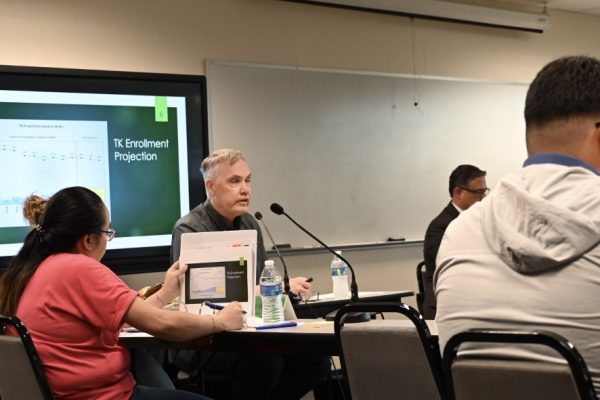
Quiroz said, “Producing demographic analysis typically takes months, high complexity of the data and level of review. This includes data collection, validation, analysis, and creating presentation-ready materials (charts, tables, and summaries).”
Established in the previous meeting, schools will be scored under 24 criteria. Using the given data, the schools were scored based on the first six criteria during this meeting. These criteria are enrollment, diversity of students, excess classroom capacity excluding portables, net intra-district and inter-district transfers, excess classroom capacity excluding transfers and proximity to schools with the capacity to accommodate incoming students.
Emmanuel Velasquez ‘27 said, “I feel like the unique facilities [are the greatest consideration for me] because those can’t really be replaced or it would be really hard to rebuild.”
The scoring of each school was provided in the agenda. When scoring, schools were categorized by elementary, middle and high school. Schools that met the criteria were given a score of two while schools that did not meet the criteria were given a score of one. They were also ranked based on how well they met the criteria within their category. For example, based on the first criterion regarding enrollment for elementary schools, Mound Elementary School was ranked first because it had the highest enrollment while Lincoln Elementary was ranked 16th because it had the lowest enrollment.
In the next meeting taking place on May 21, schools will be scored with the next seven criteria regarding facilities using data presented by the facilities team. On June 18, the fourth meeting, schools will be scored using the following five criteria that deal with educational and student support services. Committee members will do so with information presented by the educational services department.