A24, Josh Safdie and Timothée Chalamet partner up to deliver a modern classic
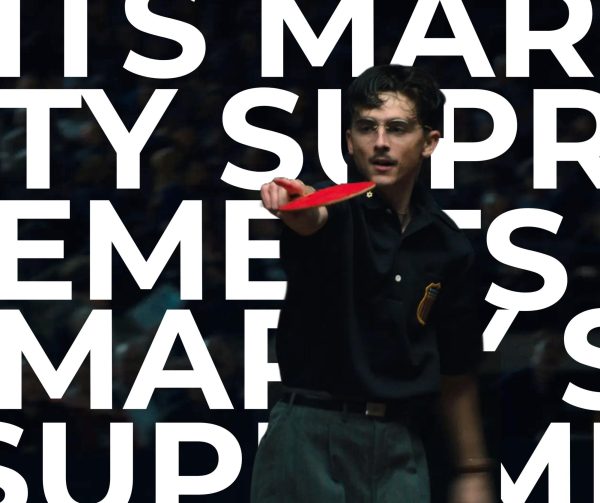
If you have been active on the internet in the past two months, you have heard of “Marty Supreme.” Whether you’ve seen Timothée Chalamet on a “Wheaties” box, Chalamet yelling “Marty Supreme is an American film that comes out on Christmas day 2025” atop the Las Vegas Sphere, the shade of “rusted orange” that took Chalamet’s visual artist six months to mock up, the “Marty Supreme” ping pong ball, Chalamet’s posse of ping pong ball headed bodyguards, the “Marty Supreme” blimp, Chalamet’s verse on UK rapper EsDeeKid’s song “4 Raws” or the sensational “Marty Supreme” jacket, the marketing team A24 assembled for “Marty Supreme” has accomplished what I believe to be the greatest movie marketing run in recent memory—beating out other competitors such as “Barbie,” “Wicked” and “The Blair Witch Project’s” respective campaigns.
But with this level of hype, there comes a very real possibility that the movie could be a massive flop, and the advertising was blowing up a balloon, or a blimp rather, that was always destined to pop. But it didn’t. “Marty Supreme” was worth all of it.
In “Marty Supreme”, Marty Mauser, the titular character, is an American Jew living in New York while it is, as IndieWire’s David Ehrlich said in his review, “1952 and the world is still picking itself up after the mess that Hitler left behind; it’s a time when everything and nothing seems possible for the generations of immigrants who’ve come to America for a better life.”
Marty is dead set on becoming the greatest table tennis player to grace the world. The film follows his Machiavellian pursuit of greatness, as he persistently makes decisions that dig him deeper and deeper into a pit that he claims a title in the World Table Tennis Championships will propel him out of.
When we meet Marty, he’s working as a salesman at his uncle’s shoe store, facing a promotion to the role of manager. But he feels that he is destined for more, spending all of his free time at his local table tennis club, where the other outsiders of New York’s Lower East Side congregate to play the game so “supreme” to Marty. Marty makes his escape and departs for an international tournament that tests his skill as well as his ego.
When he returns to New York, he is caught in a crossfire of pressures stemming from his athletic career, his old shoe sales job, his moral obligations, and a German Shepherd named Moses.
Chalamet’s hall-of-fame-level performance is backed up by a ‘92 Bulls-level trinity of supporting actors and actresses. First, Gwyneth Paltrow’s character, Kay Stone, is an old Hollywood actress. Second, her husband, the richest man in America, is Kevin “Mr. Wonderful” O’Leary’s character, Milton Rockwell. Third is Marty’s best friend, Tyler Okonma’s character Wally, a cab driver and family man who is a frequent at the table tennis club Marty calls home.
Marty’s anxiety grows as his time gets cut shorter and his looming problems grow larger. Levi Grossman ‘27 said, “[I] liked how fast-paced and action-packed it was.”

And you can feel it, Timothée Chalamet’s performance is palpable and feels real, like he is actually navigating the crazy life Marty has thrust upon himself. Marty serves as the ultimate watchdog over the pot that is his life, never allowing it to boil over by any means necessary, because all he cares about is changing his life, winning that World Championship.
Marty Supreme’s unexpected ending slams into your face and leaves you to reflect as the credits roll, and as a young man in a world where oftentimes it can feel like I am being left behind, it hit me particularly hard. As I walked out of the theater with my ping pong ball popcorn bucket, I began to ponder what the World Championship of my life is and how I can look around me and reevaluate the means to the end I am, like Marty, so desperately chasing.
From its “Forever Young” fueled title sequence to its “Everybody Wants to Rule the World” accompanied ending, “Marty Supreme” has cemented itself as a masterpiece, with Chalamet’s performance entering the Henry Mattesich trophy cabinet of the best performances of all time alongside the likes of Heath Ledger in “The Dark Knight” and Benicio del Toro in “Sicario”. The whole time you watch this film, you root for Marty while simultaneously hoping he gets what he deserves and it all blows up in his face, which is an accomplishment of director Josh Safdie just as much as it is of Chalamet. The adaptive cinematography, soundtrack, and score of “Marty Supreme” propel it further into the “modern classic” stratosphere, captivating your attention with games of table tennis and police chases alike. For my Letterboxd deflation-adjusted rating (out of five stars), I give “Marty Supreme” a 5/5 and can rest knowing that the possible greatest movie marketing campaign of all time was backed up by my favorite film of the year so far.
But I, for one, can say beyond a shadow of a doubt that I gained an arm and a leg intellectually by seeing “Marty Supreme” on Christmas Day.






![The second song [called Ca$ino] of the album features Baby Keem repressing the sad moments with his mother which made him mad and embarrassed. Graphic by: Joaquin Romero](https://thecougarpress.org/wp-content/uploads/2026/05/MEDIA-1-COVER-1200x1200.jpg)