Reviewing Etymology Nerd’s book on social media’s effect on our language
The term “cool” as a slang term became popular in the 1940’s and has managed to last for over 100 years. Surprisingly, we still commonly use this word today. On the other hand, “vsco girl” gained lots of popularity around the 2020’s but died out not long after. Why is it that some words stick around and others don’t? What does this mean for modern slang today? Will “6-7” stick around for the next decade or will it be old news by 2027?
Adam Aleksic, better known as Etymology Nerd on the internet, is a linguist and former president of the Harvard Undergraduate Linguistics Society. He has gained over three million followers on TikTok, Instagram and YouTube through his knowledge of etymology which is seen in his content, writing and speaking events such as TED Talks. In Aleksic’s first book and New York Times bestseller, “Algospeak,” published July 15, 2025, he discusses how social media affects our language.
As Aleksic describes it, media censorship is like a game of Whac-A-Mole and I couldn’t agree more. So many social media platforms like TikTok and Instagram have lots of moderation guidelines that come with censorship. But rules are followed by rulebreakers. There will always be users who will try to bypass the censorship. This is seen in the moderation against violence which can censor the word “kill.” As a result, users created the word “unalive” as a less-intense version of “suicide” to still get their content out without violating guidelines. The use of “unalive” does not pertain entirely to social media. In fact, in a placard at the Museum of Pop, it said that Kurt Cobain “un-alived himself” as a sort of euphemism for suicide.
Aside from moderation guidelines, most social media platforms will also have an algorithm that controls how content gets pushed towards an audience. Aleksic describes this as a cycle where creators produce content that needs to gain interaction for the algorithm to recommend it to a bigger audience. Any interaction to content can include watch time, comments, likes and shares. And it doesn’t matter whether the interaction is negative or positive because the algorithm still counts it as content engagement which it sees as something interesting people will want to consume. Thus, it will push the content to more people. To me, I saw this cycle as a reward system for content creators to produce good content that is then rewarded by the algorithm with more traction. The cycle repeats when the creator produces more content that they know will be rewarded by the algorithm.
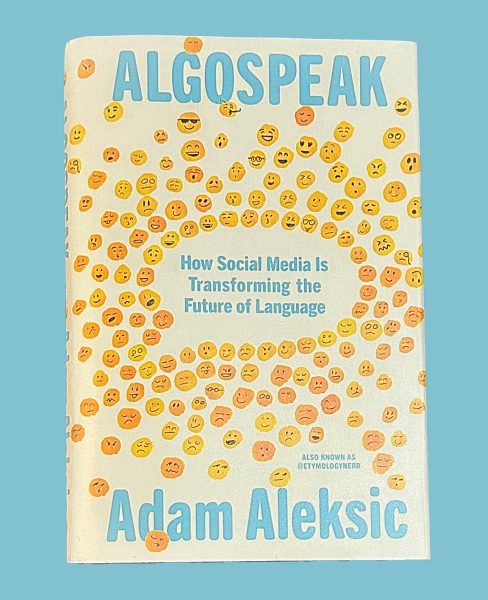
To create interesting content, Aleksic acknowledges in the book that content creators have to be experts and know their audience’s interests to keep people engaged in their content. Not knowing how to keep an audience can lead to people scrolling over their content. Oftentimes influencers, especially with the rise of short-form content, will begin their videos with “buzz words” that prevent users from scrolling. They may use interjections like “stop” or commanding statements like “you need to try this” to disrupt your attention and bring the focus towards them. In his book, Aleksic uses YouTuber MrBeast as an example. MrBeast gains popularity by creating extreme videos that garner better engagement. Word choice is not the only thing that influencers have changed in their content. Creators will quite literally adapt their content to appeal to their audience. That’s why some creators base their content on ragebait, clickbait or misinformation. Content creators can also use trending phrases to spark more engagement as well. One example of this is seen during the popularity of the “24 karat gold Labubu.” Once it became popular, suddenly thousands of videos were created playing off of the trend. And obviously, viewers will also be affected by the trend.
Emily Gutierrez ‘29 said, “If you see someone really popular on TikTok [that uses slang], that’s where you’re gonna be like ‘I’m going to start to say that.’”
Content creators have been changing the way they talk as well. Some people may choose to speak faster and others may choose to assimilate into Western culture. Influencer Sara Deshmukh chose to speak in a British accent rather than her Indian accent in her videos because she felt that she was only seen as “‘aspirational,’ but only in [her] British accent.” This heavily reflects that a lot of social media is centered around Western culture, which has socially conditioned us to believe that certain accents, like a British accent, are favorable because they are associated with wealth and prestige. Because of this, content creators may have to develop an online persona that will appeal better to the audience than their true selves like Deshmukh. Unfortunately, because of this, lots of smaller regional dialects have been disappearing because of the focus on Western culture.
While the goal for most creators is to maximize the size of their audience, it is very difficult to produce content that is both interesting and appealing to a general audience. As a result, the algorithm and influencers have played a big role in the creation of many, many, many subcultures. The algorithm suggests content specifically for individual users based on the past interactions they’ve had with previous posts. More interaction to a certain post will make the algorithm suggest similar content. In a way this divides us based on our interests and our beliefs but also unites us into smaller groups of people who share the same ideals as us.
When the algorithm spoonfeeds us the content we watch, it begs the question: is your FYP reflective of your identity or is your identity reflective of your FYP? Almost any word can be slapped with “-core” at the end and it becomes a new aesthetic that appeals to a specific audience but also categorizes people into labels that don’t perfectly define everyone. In the end, Aleksic writes that it’s just another way to find more target audiences to market to. “One can easily forget that these platforms are businesses first…If the algorithm spreads new workers and identities that build communities, that’s because the platform believes those communities will earn it more money in the end,” he writes.
Julian Owens ‘28 said, “Some [slang terms] are words that we didn’t really have before that help us say something we couldn’t before.”
The formation of these subcultures also creates new dialects. The anime community created terms like “yandere” and “tsundre” though these terms did not exactly become popular. On the other hand, the tech community invented words like “software” and “email,” and they were originally niche terms but are now widely used today. Aleksic attributes the popularity to certain words when they fill a semantic gap that couldn’t be fulfilled with any of the current words in our vocabulary. Certain phrases may also continue to live because they feel unobtrusive to our language. Aleksic claims that “yeet,” popularized in 2010, died out because it stuck out very clearly in our language. Another factor that may have contributed to the fall of “yeet” is that it became uncool when the older generation started becoming part of the “in-group” that knew what it meant. Once the in-group becomes bigger than the out-group, the word is no longer cool. He also notes that words that reflect cultural concepts such as “uwu,” used to make fun of the anime community, will also gain popularity.
As interesting as it is to see the birth of new subcultures, there is a “morally gray area” as Aleksic describes. The word “acoustic” in 2023 was originally a term used within the autism community as a funny synonym of “autistic.” The word was later used in an insulting way against autistic people once it got popular outside of the neurodivergent community.

Additionally, subcultures become a host to a community of people to exchange similar beliefs which can lead to communities becoming “large echo chambers” that can create impact outside of the community. For instance, incel communities like 4chan exchanged and spread lots of harmful ideas that would objectify and encourage violence towards women. Today, adding “-maxxing” and “-gooning” to denote optimizing or wasting time stems from incel culture that managed to seep into the general public. While many of us may use these terms sarcastically, there are unfortunately communities out there that use them very genuinely and the popularization of these terms make it difficult to differentiate what’s serious and what’s not. And in the end, incel ideology gains traction.
Unfortunately, subcultures can also be subjected to cultural appropriation which is seen in the usage of African American Vernacular English, also known as AAVE. In his book, Aleksic writes, “Even though African American English is constantly scrutinized, it’s also constantly sought after.” The word “cool” was originally part of AAVE in the 1940’s to mean being calm even in difficult situations but eventually became integrated into slang. During this time, AAVE and other non-conventional dialects of English were looked down upon as the “incorrect” version of English. And now, “cool” is widely accepted as part of the English language. Today, hardly anybody ever thinks of “cool” as a piece of history from Black culture. And this is no distant phenomenon left in the past. Many AAVE terms such as “period,” “cap” and “sis” have been incorporated into present-day slang. By turning AAVE into slang, it reinforces the idea that there is a wrong and right way to speak English and erases the origins in Black culture.
“[Brainrot] can entertain a lot of people but it can also create problems. It could become annoying for some people,” said Owens.
The very last chapter of “Algospeak” is titled “Are We Cooked?” and Aleksic addresses the future of where our language is going. Back in 2023, teachers were getting sick and tired of hearing “skibidi toilet” in classrooms. With the popularity of brainrot, there’s a lot of people who think the future generation will go downhill. Aleksic argues differently and instead, he claims that we are not cooked and it is normal for language to change. In fact, it is constantly changing. The rise of social media is only going to change language at a rapid rate.
While Algospeak was written in the social context of 2024, a lot of Aleksic’s findings can be heavily applied today. Teachers are still tired of students saying silly things, in this case it’s “6-7,” in class. AAVE and incel terminology are prominent in our social culture. This is all aided by the rise of social media, which isn’t going to go away any time soon. There’s a lot of important information that we can all take away from this book. Before reading this, I had no idea that different aesthetics were created to be monetized. During a time of ignorance, especially in the media, we should be understanding how things work. Therefore, this book is really helpful in understanding how the algorithm works and how it’s affecting our communication before we decide to all go speak algospeak.




![The second song [called Ca$ino] of the album features Baby Keem repressing the sad moments with his mother which made him mad and embarrassed. Graphic by: Joaquin Romero](https://thecougarpress.org/wp-content/uploads/2026/05/MEDIA-1-COVER-1200x1200.jpg)